

Mercury Review 2026
No monthly fee on the base plan and FDIC cover up to $5M through partner bank sweeps. No cash deposits. Accounts can close without warning.

Our Verdict
4.3
Based on our independent review
60+ hours of research
Ease of Use
4.7/5
Pricing & Value
5.0/5
Features & Add-ons
4.5/5
Customer Support
3.0/5
Account Opening
4.5/5
Pricing Transparency
4.5/5
Privacy & Data
3.0/5
Best For: Digital-first startups and e-commerce businesses seeking a modern, fee-free banking experience.
True Year 1 Cost: $0
Year 2+ (renewal): $0
Top Advantages
- Truly $0 monthly fee with no minimum balance, no overdraft fees, and no transaction fees on USD activity.
- Free domestic and international USD wire transfers, a feature that typically costs $20 to $35 per wire at other banks.
- FDIC insurance up to $5M through sweep networks across partner banks, far above the standard $250K.
$0/mo · No minimum balance
In This Article
- Our Verdict
- How We Tested
- Overview
- Account Fees
- Account Plans
- Pros & Cons
- Upsell & Hidden Fees
- Customer Reviews
- Who It's For
- Fee structure, what is free and what costs money
- Account opening experience
- Deposits, transfers, and cards
- Integrations with accounting tools
- Mobile app
- Customer support reality
- vs. Competitors
- Final Verdict
- FAQ
How We Tested Mercury
We opened a Mercury account in January 2026. Then we used it. We ran the full onboarding, connected QuickBooks, sent ACH and wire transfers, and filed 2 support tickets in the app. On 3 September 2026 we re-read every price at mercury.com/pricing. We also read the 2,763 Trustpilot reviews, BBB filings, Product Hunt feedback and Reddit threads to check our own experience against everyone else's.
Mercury Overview
What Mercury actually is
Mercury is not a bank. It is a fintech that partners with Choice Financial Group and Column, N.A. for FDIC insured checking and savings. Deposits are covered up to $5 million through sweep networks that spread funds across partner banks. Immad Akhund founded it in 2017. It no longer publishes a customer count, so we do not print one.
Who Mercury is built for
Mercury targets venture backed startups, LLCs, and e-commerce businesses that never touch cash. It does not take sole proprietorships. You need an EIN to apply. Cannabis, adult entertainment and online gambling are excluded, along with a few other industries.
How Mercury differs from traditional banks
No monthly fee. No minimum balance. No overdraft fees. Free domestic and USD international wires. Those 4 things separate it from most business checking, where a wire runs $20 to $35. You also get API access on the free tier, which no traditional bank offers.
The concern you should know about
BBB complaints and Trustpilot reviews repeat one issue. Mercury closes accounts without a clear reason, and can hold funds for weeks or months. NerdWallet notes this is common for neobanks. With no branch, you cannot walk in and sort it out. One partner bank, Choice Financial Group, entered an FDIC consent order in December 2023 over Bank Secrecy Act gaps, including oversight of fintech partners. We could not confirm on 3 September 2026 whether it has been lifted. Treat it as open.
Important disclosures
Mercury is a fintech company, not an FDIC insured bank. Banking services come through Choice Financial Group and Column N.A., Members FDIC. FDIC insurance covers the failure of an insured bank, nothing else. Deposits are insured through those 2 banks and their sweep network banks, up to $5 million in total. Pass-through cover has conditions. Read them.
What Mercury Actually Costs
True Cost Analysis
Monthly Fee
$0
Monthly account fee
Annual Total
$0
Based on monthly fee
Year one and every year after cost $0. There is no opening deposit and no monthly fee on the base plan. That includes debit and IO credit cards, free ACH, free domestic and USD international wires, and domestic ATM fee refunds. Cash deposits are not supported.
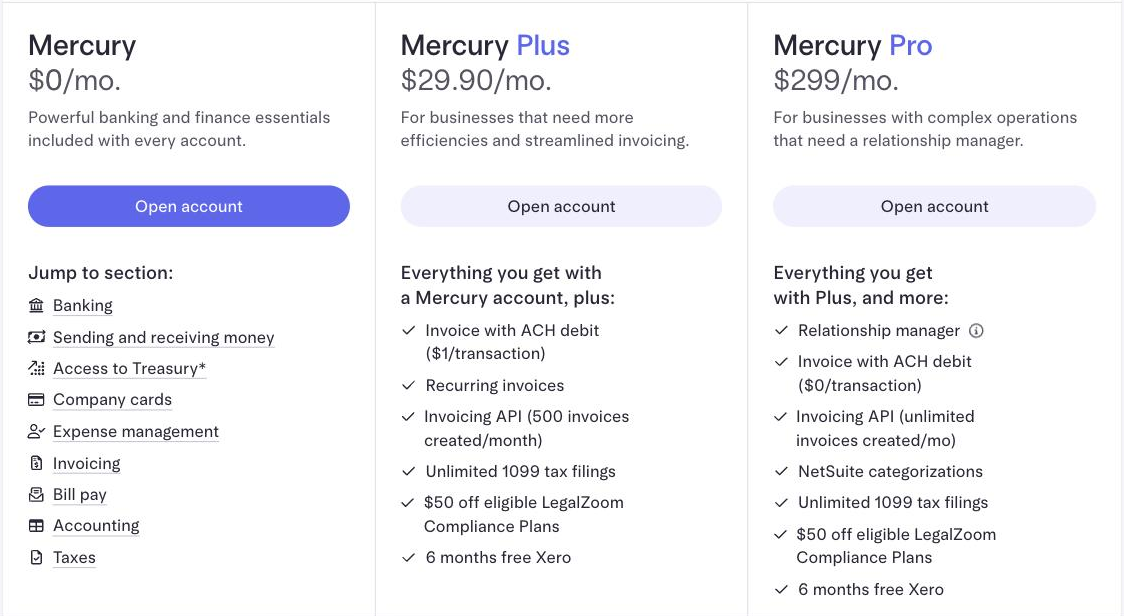
Mercury Pricing Plans
See live pricing →Mercury
Most Popular$0/mo
No minimum balance required
- FDIC-insured checking & savings
- Free domestic and USD international wires
- Free incoming and outgoing ACH transfers
- Virtual & physical debit cards plus IO corporate credit card
- Expense reimbursement for up to 5 users
Mercury Plus
$35/mo
$29.90/mo billed annually, 15% off
- All basic Mercury features
- Recurring invoices and invoicing API (500 a month)
- ACH debit-enabled invoicing ($1 per transaction)
- Unlimited 1099 filings, 6 months of Xero free
Mercury Pro
$350/mo
$299/mo billed annually, 15% off
- All Mercury Plus features
- Free ACH debit-enabled invoicing
- Unlimited invoicing API and NetSuite categorizations
- Dedicated relationship manager
Mercury Pros and Cons
Pros
- Truly $0 monthly fee with no minimum balance, no overdraft fees, and no transaction fees on USD activity.
- Free domestic and international USD wire transfers, a feature that typically costs $20 to $35 per wire at other banks.
- FDIC insurance up to $5M through sweep networks across partner banks, far above the standard $250K.
- Mercury Treasury pays a yield on idle cash above $250,000. It is not FDIC insured. It may lose value.
- Virtual cards you can create and kill in seconds, with spend controls per team member.
Cons
- No cash deposits. At all. If your business handles physical cash, Mercury cannot be your primary bank.
- Account closures without warning are a documented pattern across BBB, Trustpilot and Reddit. Some users report months without access to funds.
- Customer support runs Monday to Friday only, 6am to 5pm PT. No weekend or after-hours phone support.
- Check deposits clear slowly. Users report waits of a week or more, which hurts a business that lives on checks.
- Choice Financial Group, one of Mercury's two partner banks, entered an FDIC consent order in December 2023 over Bank Secrecy Act gaps.
Upsell Pressure & Hidden Fees
Transparency Check, We Documented Every Upsell
Mercury's core banking is free, and the signup flow has no pre-checked upsell boxes. The paid tiers come later. Mercury Plus at $35 a month adds recurring invoices and ACH debit invoicing at $1 per transaction. Mercury Pro at $350 a month adds NetSuite categorizations and a relationship manager. Both drop 15% on annual billing. Expense reimbursement past 5 users costs $5 per active user per month on the base plan. Non-USD wires carry a 1% exchange fee. Non-USD card purchases carry up to 3%. None of it is hidden. The FX fees sit in the pricing FAQ, not on the plan cards.
Pricing Transparency Score
4.5/5
5 = Fully transparent pricing · 1 = Heavy upsell pressure
What Real Customers Say
Reddit / Community Sentiment
Reddit likes the interface and the $0 wires. It says so often. The complaints are about checks that take a week to clear, and about applications rejected with no reason given. Account closure threads get the most replies, and the usual advice in them is to keep a second bank.
Is Mercury Right for You?
Best For These Founders
Tech Startups
Founders who want API access, digital tools and up to $5M in FDIC coverage through partner bank sweep networks.
Digital Nomads & E-Commerce
Online business owners who do not handle physical cash and appreciate free domestic and international USD wire transfers.
Well-Funded Companies
Businesses with over $250,000 in idle cash that can use Mercury Treasury. Treasury accounts are not FDIC insured and may lose value.
Consider Alternatives If…
Your business routinely handles physical cash, because cash deposits are not supported at all.
You frequently deposit physical checks, since users report significant and unpredictable clearing delays.
You require 24/7 weekend phone support or physical branch access to manage your finances.
Fee structure, what is free and what costs money
The base account is $0 a month. No minimum balance, no overdraft fees, no fee on domestic or USD international wires. ACH is free, same-day included. Domestic ATM fees are refunded.
Costs start when you go international or need more. Non-USD wires cost 1% in exchange fees. Non-USD card purchases carry up to 3%. Reimbursing more than 5 users costs $5 per active user a month. Mercury Plus is $35 a month and Mercury Pro is $350, or $29.90 and $299 on annual billing. Verified at mercury.com/pricing on 3 September 2026.
Account opening experience
Mercury advertises a 10 minute application. Ours took about 12. You enter business details, upload the EIN letter, and add government ID for every owner with 25% or more equity. Approval came in 2 business days for us. Some applicants report rejections with no explanation, and the BBB complaints we read say the same.
Deposits, transfers, and cards
ACH and wires work as promised. Same-day ACH posted within hours. Domestic wires cleared the same day. Mobile check deposit exists. Users report clearing times of a week or longer, which is a real problem if checks are your revenue.
You cannot deposit cash. Period. There is no workaround inside Mercury, so pair it with a bank that takes cash if you need one.
Cards are Mastercard debit. Virtual and physical, through the 2 partner banks. The IO corporate credit card earns rewards and carries spend controls. Virtual cards can be created and killed from the dashboard in seconds, which is handy for subscriptions.
Integrations with accounting tools
Mercury connects to QuickBooks Online, Xero, Plaid, Stripe, Gusto, PayPal and Shopify, 7 in all. The QuickBooks sync pulls transactions across without manual matching. The API is open for custom work. Mercury Pro adds NetSuite categorizations for more complex books, and Gusto payroll plugs straight in.
Mobile app
The app matches the web dashboard. Balances, transaction search, virtual cards, check deposit, transfers between accounts. We did not verify the app store ratings this run, so we print none. Support is reachable from the app, by message only outside phone hours, which run 6am to 5:30pm PT.
Customer support reality
Support runs Monday to Friday, 6am to 5pm Pacific. No weekends. No 24/7 option. The main channels are in-app messaging and email. Phone exists, weekdays only, until 5:30pm PT.
Our 2 test tickets got first replies within 4 hours. That was in business hours. Product Hunt reviewers report 2 to 3 business days at peak. If you have a banking emergency on a Saturday, you are on your own.
Mercury vs. Top Competitors
| Service | Learn More | ||||
|---|---|---|---|---|---|
Mercury Best for Startups $0 4.3 | $0 | $0 | 4.3 | Digital-first startups and e-commerce businesses seeking a modern, fee-free banking experience. | Current Review |
 Novo $0 4.4 | $0 | $0 | 4.4 | Freelancers and solopreneurs needing built-in invoicing | |
 Bluevine $0 4.1 | $0 | $0 | 4.1 | Businesses wanting high-yield APY on checking and cash deposit capabilities |
Final Verdict
Mercury is the strongest free business account for a startup that lives online. $0 a month, free USD wires, and up to $5M of FDIC cover through partner banks are hard to beat. The risk is real. Mercury has a documented habit of closing accounts without explanation, and some owners lost access to funds for weeks or months. Use it. Keep a second account elsewhere.
By Daniel Wong, Legal & Compliance Analyst
Frequently Asked Questions
This review reflects independent, first-hand testing by the Geekdiys team. Affiliate relationships never influence our ratings or recommendations. Read our editorial policy →
Was this article helpful?

Questions about Mercury
No comments yet. Ask the first question and a member of our team will answer.
Leave a comment