
How to Start a Business in Ohio
Ohio is home to more than 940,000 small businesses, representing 99.6% of all employers in the state.

In This Article
- All Steps at a Glance
- Key Facts & Fees
- Before You Start
- 1. Validate Your Business Idea
- 2. Write a Business Plan
- 3. Choose Your Business Structure
- 4. Choose and Register Your Business Name
- 5. Register Your Business with the State
- 6. Get Your Federal EIN
- 7. Get Your Licenses and Permits
- 8. Open a Business Bank Account
- 9. Set Up Accounting and Understand Your Ohio Taxes
- 10. Get Business Insurance
- 11. Build Your Online Presence
- 12. Stay Compliant After Forming
- State Background
- FAQ
- Next Steps
The Complete Guide
How to Start a Business in Ohio — 12 Steps
This is a full walkthrough: entity selection, state registration, federal tax IDs, licenses, banking, insurance, and ongoing compliance. Every step includes the official Ohio links, fees, and timelines.
Cost depends on your structure. A sole proprietorship may cost nothing to start. An LLC costs $99 to file online. A corporation costs $99. Step 3 walks through every option.
Ohio: Key Business Facts
Updated August 25, 2026- LLC Filing Fee (Online)
- $99
- Sole Proprietorship / DBA
- $125
- Corporation Filing
- $99
- Processing Time
- 2-3 weeks
- Expedited Option
- $100 for 2-day / $300 for 1-hour…*
- State Income Tax
- 0% to 3.5% (graduated brackets)
- Sales Tax Rate
- 5.75%
- Gross Receipts Tax
- Yes
- Franchise / Annual Tax
- Commercial Activity Tax (CAT)…**
- Filed With
- Ohio Secretary of State
- State Business License
- Not required (check local)
- Last Verified
- August 25, 2026
* Expedited Option: $100 for 2-day / $300 for 1-hour walk-in
** Franchise / Annual Tax: Commercial Activity Tax (CAT) applies only if Ohio taxable gross receipts exceed $6 million
Local licenses: Ohio does not require a general state business license. Most cities and counties require their own local business licenses, typically costing $25 to $200 depending on your location and industry.
What It Takes to Start a Business in Ohio
Ohio is home to more than 940,000 small businesses, representing 99.6% of all employers in the state. With a $99 LLC filing fee and no annual report requirement, your startup costs and ongoing compliance burden remain among the lowest in the country. This guide walks you through every step from validating your idea to staying compliant after formation.
Forming a business in Ohio requires filing with the Ohio Secretary of State and obtaining an EIN from the IRS. Most founders also need local licenses or permits depending on their city and industry.
Ohio stands out because it charges no recurring annual report fees for LLCs or corporations. That makes year-over-year compliance simpler and cheaper than in most other states.
Validate Your Business Idea
Test your concept against Ohio's strongest industries before investing time and money. The state's economy is anchored by sectors with consistent demand:
- Healthcare and biomedical (Cleveland Clinic, Ohio State Wexner Medical Center)
- Advanced manufacturing and automotive
- Technology and financial services (Columbus is a top fintech hub)
Contact the Ohio Small Business Development Center (SBDC) for free one-on-one market research consultations. Their advisors help you assess demand, identify competitors, and refine your revenue model at no cost.
Pro Tip
Write a Business Plan
A written business plan is required by most banks and the SBA when you apply for financing. Even if you self-fund, a plan forces you to map out revenue projections, expenses, and your break-even timeline.
Follow our step-by-step business plan guide to build a plan that lenders actually read. Focus on the financial projections section, since that is what loan officers evaluate first.
Pro Tip
Choose Your Business Structure
Most founders in Ohio choose an LLC because it combines personal liability protection with pass-through taxation. Filing an LLC costs $99 at the Ohio Secretary of State.
The four main structures are sole proprietorship, LLC, S-Corp, and C-Corp. Each has different tax treatment and liability implications. See the full comparison below, or read our Ohio LLC formation guide for a deeper breakdown.
Pro Tip
Important
Business Structure Comparison — Ohio
Full comparison guide| Structure | Ohio Filing Cost | Personal Liability | How You're Taxed | Best For |
|---|---|---|---|---|
| Sole Proprietorship | $125 (DBA) | ❌ None | Personal income tax. No separate return. | Freelancers, consultants, side hustles testing an idea with no employees. |
| LLC Most Common | $99 online | ✅ Personal assets protected | Pass-through by default. Elect S-Corp when profitable. | Most small businesses. Best balance of liability protection, flexibility, and tax options. |
| S-Corporation | ~$99 + IRS election | ✅ Personal assets protected | Pass-through. Owners pay themselves a salary — can reduce self-employment tax. | Profitable businesses (typically $50K+ net) where payroll tax savings justify the complexity. |
| C-Corporation | $99 | ✅ Personal assets protected | Corporate tax rate (21% federal). Double taxation on dividends. | Startups planning to raise VC funding, issue stock options, or eventually go public. |
| General Partnership | Free / No State Filing | ❌ None — all partners personally liable | Pass-through. Each partner reports share on personal return. | Two or more owners who trust each other and don't need liability protection. |
Which should you choose? Most first-time founders in Ohio pick an LLC — it protects your personal assets without the complexity of a corporation. If you're not sure, consult a CPA or business attorney before filing. Read the full Ohio LLC guide →
Choose and Register Your Business Name
Your business name must be distinguishable from every other entity registered in Ohio. Search the Ohio Secretary of State business database to confirm availability before filing.
LLCs must include "LLC" or "Limited Liability Company" in the official name. You can reserve an available name for $39 for up to 180 days if you are not ready to file immediately.
Pro Tip
Check Ohio Business Name Availability
Search the official Ohio Secretary of State database before you file.
Register Your Business with the State
File your Articles of Organization with the Ohio Secretary of State online for $99. Standard processing takes 2 to 3 weeks, but you can pay $100 for 2-day expedited service or $300 for 1-hour walk-in processing in Columbus.
After approval, you receive a stamped Certificate of Organization confirming your LLC exists. Ohio does not legally require a registered agent, but appointing one keeps your home address off public records and ensures you never miss legal notices. See our Ohio registered agent guide for options.
Pro Tip
File Online with Ohio Secretary of State
Official Ohio business registration portal. Standard processing: 2-3 weeks.
Get Your Federal EIN
Apply for a free Employer Identification Number (EIN) directly from the IRS online portal. The process takes about 10 minutes, and you receive your EIN immediately upon completion.
You need an EIN to open a business bank account, hire employees, and file federal taxes. Even single-member LLCs should get one to avoid using a personal Social Security number on invoices and tax forms.
Pro Tip
Important
Get Your Licenses and Permits
Requirements vary by industry and location, but most Ohio businesses need some combination of the following:
- Vendor's License (Sales Tax Permit) required if selling taxable goods or services; register free at the Ohio Department of Taxation
- Local Business License required by most Ohio cities and counties, typically $25 to $200; check with your city clerk's office
- Professional License required for contractors, healthcare providers, real estate agents, barbers, and other regulated professions through the Ohio eLicense portal
- Employer Registration required before hiring your first employee; register with the Ohio Department of Job and Family Services for unemployment insurance
Pro Tip
Important
Open a Business Bank Account
Bring your EIN confirmation letter, Articles of Organization, government-issued ID, and your LLC operating agreement to the bank. Most Ohio banks and credit unions can open a business checking account the same day.
Keeping personal and business finances separate protects your LLC's liability shield and simplifies tax filing. Compare fee structures and features in our best business bank accounts guide.
Pro Tip
Set Up Accounting and Understand Your Ohio Taxes
Ohio's personal income tax ranges from 0% to 3.5% across graduated brackets, with the first $26,050 of income exempt from state tax. If your Ohio taxable gross receipts run over $6 million a year, you must also pay the Commercial Activity Tax (CAT).
Ohio's state sales tax rate is 5.75%, with local additions bringing the combined rate to 7% to 8% in most counties. Register for your Vendor's License at the Ohio Department of Taxation before making taxable sales.
Set up cloud accounting software from day one to track income and expenses automatically. See our best accounting software picks for options starting at $0/month.
Pro Tip
Get Business Insurance
Ohio requires workers' compensation insurance for all employers. Register with the Ohio Bureau of Workers' Compensation (BWC) before hiring your first employee. Ohio is a monopolistic state for workers' comp, meaning you must purchase coverage directly from BWC.
General liability insurance is the baseline policy every business should carry, even without employees. Compare quotes and learn more in our best business insurance guide.
Pro Tip
Important
Build Your Online Presence
Claim your free Google Business Profile to appear in local search results and Google Maps. This single step drives more local leads than almost any other marketing tactic for new businesses.
Build a simple website with your services, pricing, and contact info. Our best website builders guide compares platforms starting at $0/month for basic sites.
Pro Tip
Stay Compliant After Forming
After forming, keep your Ohio business in good standing by meeting these ongoing requirements:
- Annual Reports are not required in Ohio for LLCs or corporations, saving you both fees and paperwork every year
- Commercial Activity Tax (CAT) only once your Ohio taxable gross receipts pass $6 million a year, then register within 30 days and file quarterly; register at the Ohio Department of Taxation
- State Income Tax file an annual Ohio IT 1040 return by April 15; pay quarterly estimated taxes if you expect to owe more than $500
- Registered Agent if you appointed one, maintain a valid agent with an Ohio street address at all times
- Local Business Licenses renew any city or county permits on their annual renewal dates
Ohio's lack of annual report fees keeps your compliance costs minimal. Track all deadlines with Geekdiys's compliance calendar.
Pro Tip
Important
Ohio Business Background & Context
State-specific data to help you plan — taxes, economy, funding, and what to expect after you form.
Ohio's LLC filing fee is just $99, and the state charges $0 in annual report fees. That makes it one of the cheapest states in the country for long-term business ownership.
The state's GDP exceeds $820 billion, ranking it 7th nationally. Ohio offers a massive consumer base of nearly 12 million residents across diverse urban and rural markets.
Columbus, Cleveland, and Cincinnati are all ranked among the top cities for startup ecosystems in the Midwest. Columbus alone has attracted over $2 billion in venture capital funding in recent years.
Ohio's central location provides road, rail, and air access to 60% of the U.S. and Canadian population within a 600-mile radius. That logistics advantage matters for e-commerce, distribution, and manufacturing businesses.
The state invests heavily in workforce training through Ohio TechCred, which reimburses employers up to $2,000 per employee for technology-focused credentials. Programs like this reduce your training costs from day one.
Ohio Business Climate
Ohio's personal income tax tops out at 3.5%, with the first $26,050 exempt from state income tax. There is no corporate income tax, and the Commercial Activity Tax that replaces it only reaches businesses with more than $6 million in annual Ohio taxable gross receipts.
The state does not require annual reports or charge ongoing entity maintenance fees. This puts Ohio ahead of neighboring states like Pennsylvania and Indiana on annual compliance costs.
Ohio ranks 5th on the Tax Foundation's State Business Tax Climate Index for individual income tax structure. The graduated rate system keeps tax burdens low for small and mid-size businesses.
Regulatory burden is moderate. Ohio does not require a general state business license, though most municipalities have their own licensing requirements. Professional licensing is handled through the centralized eLicense portal.
Healthcare and Biomedical employs over 700,000 Ohioans and anchors the economies of Cleveland, Columbus, and Cincinnati. The Cleveland Clinic and Ohio State University Wexner Medical Center are world-class institutions driving demand for support businesses.
Advanced Manufacturing contributes over $100 billion to Ohio's GDP annually. The state ranks 3rd nationally in manufacturing employment.
Technology and Fintech has surged in Columbus, which is home to the Midwest's fastest-growing tech corridor. Major employers include JPMorgan Chase, Nationwide, and a growing roster of SaaS startups.
Logistics and Distribution thrives due to Ohio's central geography and infrastructure. The state has 5 major interstate highways and access to Lake Erie shipping routes.
Agriculture and Food Processing generates over $9 billion in annual cash receipts. Ohio ranks in the top 10 nationally for soybeans, corn, and dairy production.
Energy and Clean Tech is expanding as Ohio invests in natural gas, solar, and wind. Intel's $20 billion semiconductor fabrication campus in Licking County is expected to create thousands of supply chain opportunities.
Ohio's personal income tax uses graduated brackets with rates from 0% to 3.5%. The first $26,050 of taxable income is fully exempt, which benefits new businesses with modest first-year earnings.
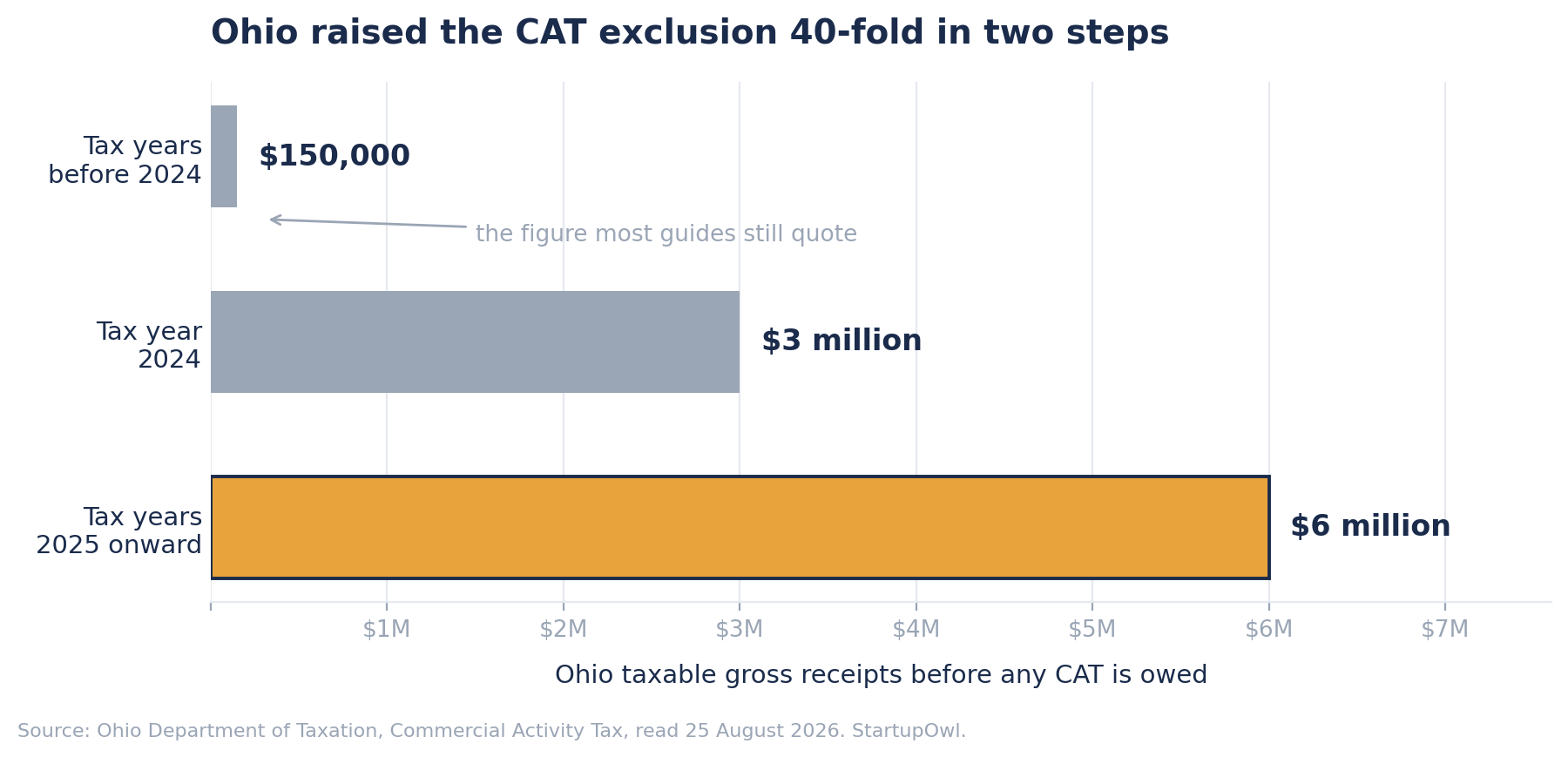
Ohio does not impose a traditional corporate income tax. Instead, the Commercial Activity Tax (CAT) applies only to businesses with more than $6 million in annual Ohio taxable gross receipts, a threshold the state raised from $150,000 in two steps across 2024 and 2025. The CAT rate is 0.26%, charged on receipts above that $6 million exclusion.
The state sales tax rate is 5.75%. County and transit authority surcharges push the combined rate to 7% to 8% in most areas. Cuyahoga County (Cleveland) has one of the highest combined rates at 8%.
There is no inventory tax in Ohio, which benefits retailers, wholesalers, and manufacturers. Tangible personal property used in business is also exempt from state property tax.
Ohio employers pay state unemployment tax (SUTA) at rates ranging from 0.3% to 9.2% on the first $9,000 of each employee's wages. New employers typically start at 2.7%.
Register for all state tax accounts at the Ohio Department of Taxation. You can manage vendor's license, CAT, and income tax filings through the Ohio Business Gateway portal.
Ohio's cost of living index is approximately 89.5 (national average = 100), making it one of the most affordable states for launching a business. Housing, utilities, and office space all fall well below the national median.
Average commercial office rent in Columbus ranges from $18 to $24 per square foot annually, compared to $35+ in major coastal cities. Cleveland and Cincinnati offer even lower rates in the $14 to $20 range.
Ohio's average annual wage is approximately $53,000, about 8% below the national average. That translates to lower payroll costs for businesses hiring locally while still accessing a skilled talent pool from Ohio's 14 public universities.
Energy costs in Ohio average around $0.12 per kWh for commercial customers, close to the national average. Natural gas prices tend to be lower than the national median due to in-state Marcellus and Utica shale production.
The Ohio Small Business Development Center (SBDC) offers free business advising, market research, and help preparing loan applications. There are 30+ offices across the state.
The SBA Columbus District Office connects Ohio founders with SBA-backed loans, microloans up to $50,000, and the 7(a) loan program for amounts up to $5 million.
Ohio's Department of Development offers incentive programs including the Ohio Opportunity Zone Tax Credit, the JobsOhio Workforce Grant (up to $1 million for job creation), and the Ohio Innovation Fund for tech startups.
The Minority Business Assistance Center (MBAC) network provides free mentoring and loan packaging for minority-owned businesses across Ohio. Contact your regional MBAC through the Ohio Department of Development website.
In your first 30 days, open your business bank account, set up accounting software, and register for your Ohio Vendor's License if you sell taxable goods. Apply for any required city or county business licenses before you begin operating.
By day 60, secure general liability insurance and, if you plan to hire, register with the Ohio Bureau of Workers' Compensation. File your first quarterly estimated tax payment if your formation date falls in a quarter where you earn revenue.
Before day 90, launch your website and Google Business Profile, set up payroll if you have employees, and confirm that all license applications have been approved. Use Geekdiys's compliance calendar to track every deadline going forward.
Frequently Asked Questions
What to Do Next
Once you've registered your Ohio business, take these steps to set up for success.
Form Your Ohio LLC
File your Articles of Organization with the Ohio Secretary of State for $99. Our guide walks you through every field.
Start Your Ohio LLC →
Get a Registered Agent
Keep your home address private and ensure you never miss legal mail. Compare Ohio registered agent services.
Compare Agents →
Open a Business Bank Account
Separate your personal and business finances to protect your LLC status and simplify tax season.
See Top Accounts →
Connect with the Ohio SBDC
Get free one-on-one advising, market research, and loan application help from Ohio SBDC counselors.
Find Your Local SBDC →
Write Your Business Plan
A strong plan is your ticket to SBA loans and bank financing. Use our free template to build one fast.
Build Your Plan →
Disclaimer: This guide is for informational purposes only and does not constitute legal or tax advice. Requirements change — always verify current fees and requirements directly with Ohio Secretary of State and the IRS before filing.

Ready to Form?
Get your Ohio business registered with Northwest. $39 + state fee includes registered agent, business address, domain, and more.
Was this article helpful?
Questions about starting a business in Ohio
6 comments
Selma Aguirre
August 30, 2026
Opening a small shop selling kitchen equipment. This page mentions local licences generally and my county clerk says I need something before I can ring up a single sale, but calls it a different name from anything written here. Is that a licence or a tax registration, and who issues it?
Jennifer PayneGeekdiys team
Director of Entrepreneurial Strategy · September 1, 2026
It is a tax registration wearing the word licence, which is why the names do not line up. What you need is a vendor's licence, and in Ohio it is issued by the county auditor rather than by the city or the state, which is the part nobody guesses. It gives you the authority to charge sales tax and it has to be in place before your first taxable sale, not before your first return. It is a one off application with a modest fee, and it is tied to the location, so a second shop in another county needs its own. Once you have it you file sales tax returns with the state even in months when you sold nothing, so put the filing schedule in the calendar the same day.
deb_c
August 17, 2026
your commercial activity tax number is way off and it nearly cost me a morning. this page says it kicks in over one hundred and fifty thousand and the state's own site put me somewhere completely different. i registered for something i did not need before i noticed. can you check it
Jennifer PayneGeekdiys team
Director of Entrepreneurial Strategy · August 18, 2026
You are right and the number on this page is badly out of date, so thank you, we are correcting it. Ohio raised the commercial activity tax exclusion in stages and it now sits at several million in taxable gross receipts rather than the figure we printed, which is a difference of about forty times. Under the current exclusion most small businesses owe nothing and are not required to file a return at all. If you registered an account you do not need, you can formally cancel it with the Department of Taxation rather than leaving it open filing zeroes, which is the tidier fix. Two things to carry away. The exclusion is on gross receipts, not profit, so it is your turnover you compare it against. And the rate above the exclusion applies only to the excess, not to the whole.
Everett Pike
August 13, 2026
Setting up a small design studio in Cincinnati with a couple of contractors. My accountant says I will be filing a city return as well as a state one, and that depending on where clients are I might end up filing in several cities. That cannot be right for a business with one office, surely.
Jennifer PayneGeekdiys team
Director of Entrepreneurial Strategy · August 13, 2026
It is right, and Ohio is the only state where it works at this scale. Roughly six hundred Ohio municipalities levy their own income tax on business net profit, and they are collected three different ways, some by the city itself, some by the Regional Income Tax Agency, some by the Central Collection Agency. Which one you deal with depends on the city, not on you. And yes, a business can owe in more than one, because the tax generally follows where the work is performed, so a studio whose people work at client sites can pick up filings it never asked for. The thing worth knowing is that Ohio lets a business elect to file all its municipal net profit tax centrally with the state instead, on one return through the state's business gateway, and the state then distributes it. For a company facing several cities that election is usually the whole difference.
Leave a comment