Shopify Capital Review and the Best Alternatives for 2026
Shopify Capital is good money behind a locked door. You cannot ask.
- You cannot apply to Shopify Capital, their model decides who sees offers, and 90 days on Shopify plus clean standing are just the minimums.
- The cost is a flat amount per offer with no published fee ranges, divide the fee by the advance and weigh your repayment speed before accepting.
- Wayflyer is the tested alternative you can apply to, one fixed 5% to 10% fee, funding in 24 to 48 hours, and the same sales flexed repayment style.
- Repayment runs on your daily sales in both worlds, Capital caps at 18 months with two minimum payments.
Shopify Capital is good money behind a locked door. You cannot ask. The model picks you, then you apply, and that application can still be refused. We price both fee structures and rank the tested funders a Shopify brand can apply to today, Wayflyer first.
You cannot ask Shopify Capital for money. It has to offer first. Shopify's model watches your store, and if it likes what it sees, an offer of up to $2 million appears in your admin. Then you apply, and Shopify can still say no. This page explains how Capital really works, which of its two fee structures costs less, and what strong Shopify brands do when the invitation never comes.

Wayflyer
Fee from 5%
Get a Funding OfferSide-by-Side Comparison
| Feature | |||
|---|---|---|---|
| You can apply directly | Yes | Yes | Yes |
| Pricing | 5% to 10% one-time fee | 9.75% to 60% APR by lender | APR starting at 35% |
| Funding speed | 24 to 48 hours | 1 business day | Same day |
| Repayment style | Percent of daily or weekly sales | Varies by lender | Fixed daily or weekly |
| Revenue floor | $10,000+ monthly | $50,000 a year | $100,000 a year |
Full Reviews
Fee from 5%
Revenue based funding with one fixed fee, built for Shopify and Amazon brands
Time in business: 6+ months
Min. revenue: $10,000/month
Pros
- One fixed fee, typically 5% to 10%, with no application, origination, late, or prepayment charges
- Funding lands in 24 to 48 hours after approval
- Cash Advance remittances flex with your sales, slow weeks cost less
- No personal credit score requirement, underwriting reads your revenue data
- Repeat rounds usually price lower, and Rolling Financing skips reapplying
- Published eligibility floors, no guessing games
Cons
- The fee converts to roughly 14% to 36% effective APR at typical speeds, patient money is cheaper
- 3 to 9 month horizons keep repayment pressure high
- Account management complaints from larger brands, and no replies to negative Trustpilot reviews
- Dropshippers and pre-revenue businesses are refused
- Retail and service businesses need 2 years of history
Lendio gives you one application to shop 75+ lenders, but your data goes wide and final rates can climb past 50% APR.
Time in business: 6+ months
Min. revenue: $50K/year
Pros
- One 15-minute application reaches 75+ lenders, saving hours of individual applications across different platforms
- Accepts borrowers with credit scores as low as 560, giving subprime borrowers more options than most direct lenders offer
- Wide product range covering term loans, lines of credit, SBA 7(a), MCAs, equipment financing, and invoice factoring through a single portal
- Dedicated funding specialists walk first-time borrowers through product selection at no charge to the borrower
Cons
- Your personal and business data (including SSN and tax returns) is shared with multiple third-party lenders who may retain it permanently and contact you aggressively via phone, email, and text
- APR range stretches to 60%, and you cannot see actual rates until after submitting your full application, making upfront comparison impossible
- Revenue-based financing is repaid as a share of daily revenue rather than at a stated APR, so its true annualized cost is hard to compare against a term loan
- Customer support is limited to weekday business hours (Mon-Fri 7:30am-5pm MT), and multiple BBB and Reddit complaints describe unresponsive service after the initial application
- Once matched with a lender, Lendio is no longer involved in servicing your loan, leaving you without an advocate if problems arise
Fast same-day funding for fair-credit borrowers, but average APRs near 58% make OnDeck one of the most expensive online lenders we have reviewed.
Time in business: 1+ years
Min. revenue: $100K/year
Pros
- Same-day funding is genuinely available for term loans up to $200,000 if you complete checkout by 10:30 AM ET on a weekday.
- A 625 minimum FICO score and 1 year in business make OnDeck accessible to borrowers that traditional banks and SBA lenders routinely decline.
- On-time payments are reported to business credit bureaus, which helps you build a business credit profile.
- No prepayment penalty on either product, and repeat borrowers can qualify for reduced origination fees on subsequent loans.
Cons
- The average APR of 57.90% on term loans is roughly six times the 9.75% ceiling SBA sets on a 7(a) above $350,000. A $50,000 12-month term loan at this rate costs approximately $18,600 in finance charges.
- Daily or weekly automatic ACH repayments can crush cash flow during slow revenue weeks. You cannot switch to monthly payments on a term loan.
- Term loans are secured by a UCC-1 blanket lien and require a personal guarantee, meaning OnDeck can claim general business assets and pursue personal assets if you default.
- Maximum repayment terms cap at 24 months, forcing higher periodic payments compared to lenders offering 3 to 10-year terms.
- Without OnDeck's Prepayment Benefit, paying off your loan early still requires paying 75% of remaining interest, reducing the value of early repayment.
How to Choose
Strong Shopify store, no Capital offer in the admin
You apply instead of waiting. Decisions run on your store and bank data, funding lands in 24 to 48 hours, and remittances flex with sales exactly like Capital.
You have a Capital offer and want to know if it is fair
One form pulls comparable quotes from 75 plus lenders. Ten minutes of comparison prices your Capital offer honestly.
You want a plain APR you can compare against a bank
OnDeck quotes a real APR from 35%, a number you can hold next to any converted fee.

How Shopify Capital Actually Works
Shopify Capital lives inside the admin. In the US the loans come from WebBank. They are secured, the agreement takes a security interest in your business assets, and a UCC-1 may be filed. Funding reaches merchants in 9 countries. Five get loans, Australia, Canada, France, Germany and the US. Four get a merchant cash advance, Ireland, the Netherlands, Spain and the UK. You repay with a fixed cut of daily sales. Nothing is taken on a day you do not sell. The ceiling is $2 million. Eligibility is judged on your store, not your credit file. Shopify weighs sales, disputes, chargebacks, customer engagement, your time on the platform and your payment record with it. The floor is 3 months of trading.
The Invitation Problem
Eligibility is the catch. It runs in 2 stages, and most write ups collapse them into one. First the model decides whether to invite you. It reads sales, disputes and customer engagement, and it regenerates offers daily. No invitation means no path. There is no form that lets you ask. Then comes the half that gets missed. An offer is only permission to apply. You submit a real application, verify the beneficial owners, and agree the terms. Shopify reviews it in 1 to 3 business days. It can be cut, or refused. A revised amount comes back as a new offer, and you apply again. Plenty of healthy stores never reach stage one. Multichannel brands that do often see an offer sized only to their Shopify slice.
What Shopify Capital Costs
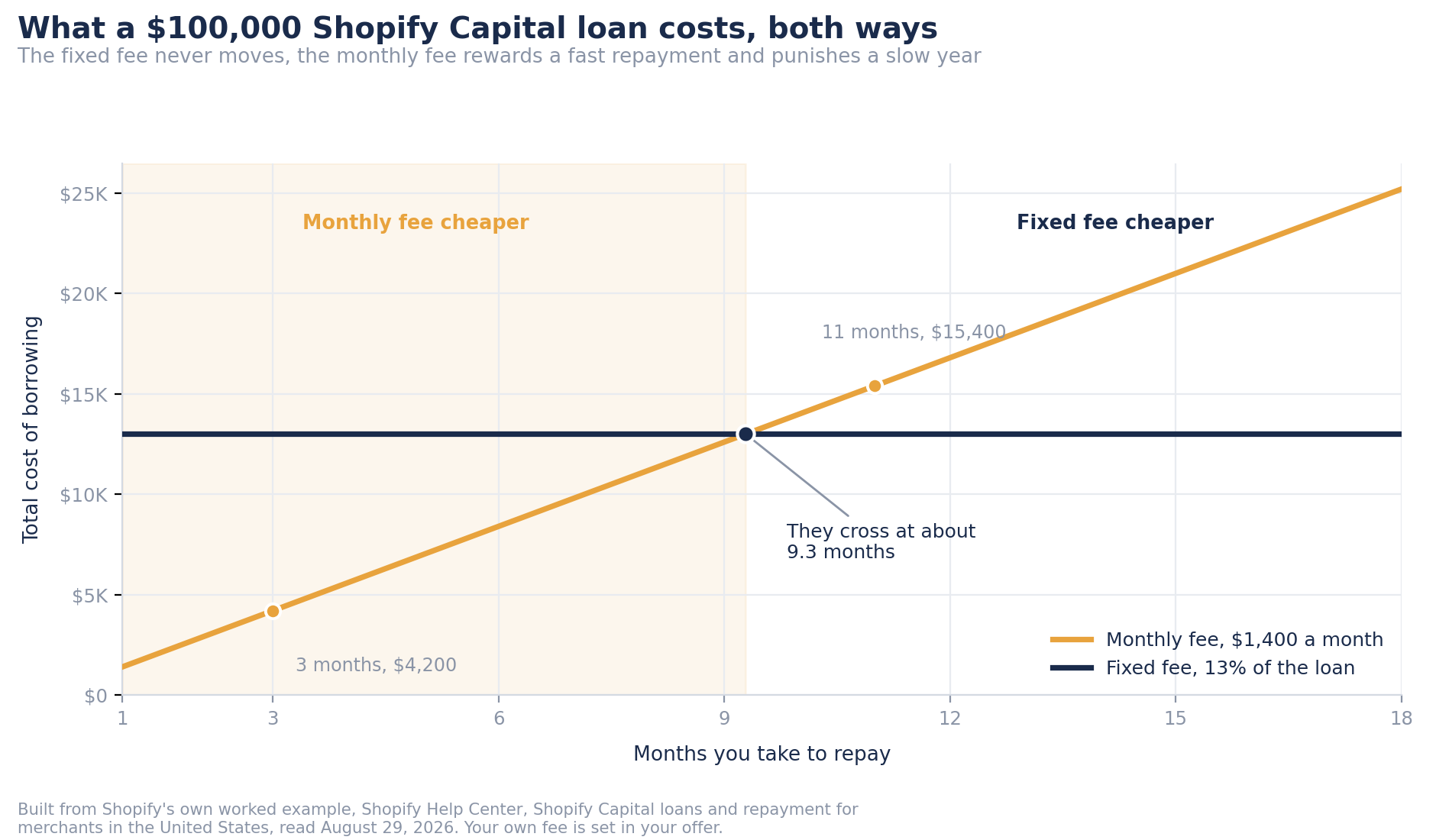
There is no interest rate to compare. In the United States there are now 2 fee structures, not one. A fixed fee is a flat percentage of the amount borrowed, charged whatever happens. A monthly fee is a set dollar amount for every month you still carry a balance. Shopify prices both on a $100,000 loan in its own example. A 13% fixed fee costs $13,000, whether you clear it in 3 months or 11. A $1,400 monthly fee costs $4,200 over 3 months and $15,400 over 11. The two cross at about nine and a half months. Repay faster and the monthly fee wins. Repay slower and the fixed fee does. Pick with a forecast, not a hunch.
Two limits sit behind both structures. The term caps at 18 months. Shopify also checks your progress twice, 30% of the loan repaid by month 6 and 60% of the total payment amount by month 12, and missing either can put you in default. Took your loan on or after March 9, 2026? Repayments now come out of your Shopify Payments balance rather than a bank debit. Our revenue based financing guide walks the fee to APR conversion in full.
The Alternatives You Can Actually Apply To
This is where the market has real answers. Wayflyer funds Shopify brands directly. You apply instead of waiting. Decisions run on your store and bank data. One fixed fee of 5% to 10%. Funding in 24 to 48 hours. Remittances flex with sales, the same style Capital uses. The floors are published, $10,000 a month and 6 months of history. Our Wayflyer review holds the honest APR math.
Want several offers to compare? One Lendio form reaches 75 plus lenders. If a transparent APR matters more than speed, OnDeck quotes a real number. The full ranking lives in our revenue based financing comparison.
Is a Capital Offer Worth Taking
Usually yes, if you do one piece of arithmetic first. Divide the fee by the advance. Divide again by the months you realistically expect to take. Hold that number against one outside quote. This matters more here than with most products, because Shopify publishes no fee range at all, while Wayflyer publishes a 5% to 10% fee before you apply. An outside quote is the only benchmark you can get before you sign. Ten minutes protects you from accepting a convenient number instead of a good one. Do it before you accept, not after.
Frequently Asked Questions
Not directly. There is no form that asks Shopify for an offer. Eligibility is evaluated automatically and recalculated daily from your store data. You can check the Finance page of your admin, but you cannot force an invitation. Once an offer does appear, you then submit a real application, and Shopify can approve it for less than the offer or decline it after review.
In the United States, Shopify reviews a submitted application in 1 to 3 business days, sometimes longer. If it is approved, the money lands in your business bank account. Daily repayments then begin within 2 business days of the disbursement. The slow part is not the money. It is waiting for an offer to appear at all, which can take months or never happen.
Shopify publishes no fee range. The number is set in your offer. In the United States you now choose between 2 structures. A fixed fee is a flat percentage of the amount borrowed, charged whatever happens. A monthly fee is a set dollar amount for every month you still carry a balance, so it rewards fast repayment and punishes a slow year. On Shopify''s own $100,000 example, a 13% fixed fee costs $13,000 either way. A $1,400 monthly fee costs $4,200 over 3 months and $15,400 over 11.
Yes, you repay a fixed percentage of daily sales, and nothing is taken on days without sales. The flexibility has a floor though. The term caps at 18 months. Shopify checks that you have repaid 30% of the loan by the six month mark and 60% of the total payment amount by twelve months. Miss either and you can be in default under the agreement, so a slow season can still bite.
Was this article helpful?
This page is for educational and informational purposes only and is not professional financial advice. Offers, fees, and eligibility change and vary by merchant. Confirm all terms directly with the provider before signing any agreement. Geekdiys earns a referral fee on some providers, which does not affect our rankings.
Questions about Shopify Capital Review and the Best Alternatives for 2026
No comments yet. Ask the first question and a member of our team will answer.
Leave a comment