Best Business Credit Cards for Small Business 2026
We scored 4 business credit cards on rewards rates, intro APR periods, annual fees, and credit requirements for small business owners. Three charge no annual fee.
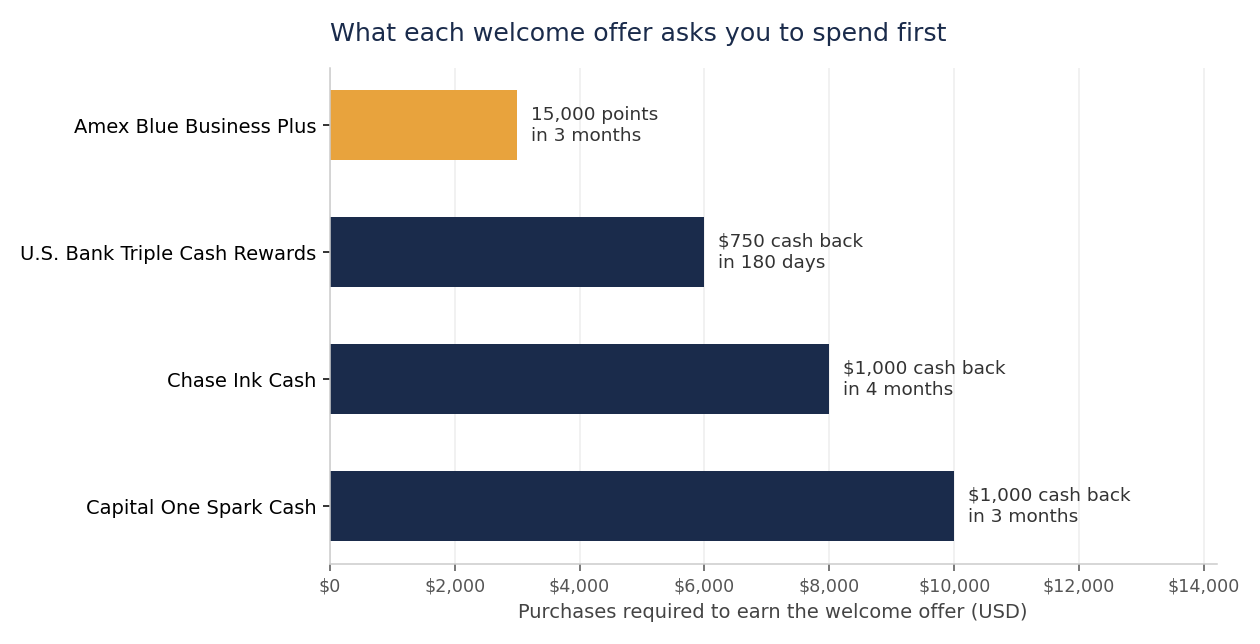
- Chase Ink Cash pays $1,000 cash back after $8,000 of purchases in your first 4 months. That is the largest verified offer here. Chase calls it their best ever.
- Capital One Spark Cash pays $1,000 after $10,000 of spending in 3 months. The annual fee is $0 for the first year, then $95, which Capital One now states plainly in its own application FAQ. Year two is where it bites.
- Spark Cash charges 24.49% variable on purchases and has no 0% intro period. Chase gives you 12 months at 0% on purchases instead. Both re-checked 20 August 2026.
- None of these issuers publishes a minimum credit score. No issuer states one. This page used to state four of them, and they were never issuer figures, so they are gone.
- Capital One's Spark Cash Plus carries no preset spending limit. Capital One says the amount you can spend moves with your behavior and credit profile. You cannot plan against it.
- U.S. Bank Triple Cash Rewards pays $750 cash back after $6,000 of purchases in 180 days, with no annual fee and a $100 credit each year for software subscriptions. Read at U.S. Bank on 20 August 2026.
We scored 4 business credit cards on rewards rates, intro APR periods, annual fees, and credit requirements for small business owners. Three charge no annual fee. Amex Blue Business Plus earns the top spot with 2X points on up to $50K in annual purchases, a 12-month 0% intro APR, and a $0 annual fee.
Four business credit cards, compared on what they cost and what they hand back. Three of them charge $0 a year. We read all four sets of terms at the issuers on 20 August 2026, and two of those product pages had moved address since our last check. Amex Blue Business Plus still suits most founders, because a flat rate on everything needs no tracking. Category spenders do better elsewhere.
How to Choose
You are a brand new business and want the biggest welcome offer you can actually verify.
Chase Ink Cash pays $1,000 cash back after $8,000 of purchases in the first 4 months. It charges no annual fee. Purchases run 0% intro APR for 12 months. All three were read off Chase's own page on 20 August 2026.
Most of your spending sits in office supplies, internet, cable or phone service.
Chase Ink Cash pays 5% cash back on the first $25,000 spent each year across office supply stores and those telecom services, and 2% on the first $25,000 at restaurants and gas stations. Both caps reset each year. Nothing else here pays a raised rate on that mix.
Your spending is scattered across software, contractors, travel and supplies, and you do not want to track categories.
A flat rate on every purchase beats category rewards once your spending stops clustering, and Membership Rewards points can move to airline and hotel partners. There is nothing to track. It earns 2X points on the first $50,000 of eligible purchases each calendar year, charges no annual fee, and runs 0% intro APR on purchases for 12 months. Read at American Express on 20 August 2026.
You buy from suppliers outside the United States.
Spark Cash charges no foreign transaction fee and pays unlimited 2% cash back with no categories and no caps, re-verified at Capital One on 28 August 2026. The purchase rate is 24.49% variable. The other cards here charge a surcharge on overseas purchases.
You want category rewards but the Chase 5/24 rule has blocked you.
U.S. Bank sits outside Chase's 5/24 restriction and its Triple Cash card pays a raised rate in a set of business categories plus an annual software credit. It pays 3% back at gas and EV charging, office supply stores, cell phone providers and restaurants, and $100 a year toward software subscriptions. Read at U.S. Bank on 20 August 2026.
Your monthly spend is large and a fixed credit limit keeps getting in the way.
The Spark Cash Plus charge card carries no preset spending limit, and Capital One states plainly that what you can spend moves with your spending behavior, payment history and credit profile. The ceiling is invisible. That flexibility runs both ways, so read our Amex financial review guide before you make it the only card payroll depends on.
You expect to carry a balance through your first year.
Chase Ink Cash gives 12 months at 0% intro APR on purchases from account opening. Capital One Spark Cash has no intro window at all and charges 24.49% variable, so the same balance costs real money there. Compare the go-to rate. Both verified at the issuers, Capital One re-checked 28 August 2026.
How We Evaluated These Business Credit Cards
We score each card on four things. Price, what the rewards actually return, how plainly the issuer states its terms, and how fast the card arrives. Every figure here is read off the issuer's own page. When we cannot reach that page, the figure does not get to pose as fresh.
Four cards made the list. We left out cards charging more than $95 a year and cards demanding more than two years of trading history. Startups do not have two years. Cards lose points for fees buried in the terms, foreign transaction surcharges, and earning caps that quietly cut the return.
Price and value carry the most weight, then ease of use, then reward flexibility, then support reputation. Every card here was re-read at its own issuer on 20 August 2026, all four. The American Express and U.S. Bank pages that beat us the day before had simply moved. Both of the old addresses now return a 404.
Who Needs a Business Credit Card
A business card suits a founder with steady monthly costs. Most founders start here. It keeps business spending out of the personal account, and it floats the gap between paying suppliers and getting paid. New businesses qualify more easily than they expect, because the issuer underwrites the owner rather than years of accounts. Sole proprietors and freelancers can apply with a Social Security number.
It is the wrong tool in three cases. You need a large lump sum, you are buying a long lived asset, or you already carry expensive personal debt. Spark Cash runs 24.49% variable, which is expensive money for a five year project. Over that horizon a term loan or a working capital loan costs less. Cards are not term debt. If your personal credit is thin, build that first, because your personal file is what the issuer reads.
Top Picks Compared in Detail
The Amex Blue Business Plus holds our top spot for one reason. It pays points on everything at one flat rate, so there is nothing to track and no category to remember. You earn 2X Membership Rewards points on the first $50,000 of eligible purchases each calendar year, then 1X. The annual fee is $0. The welcome offer is 15,000 points after $3,000 of purchases in your first 3 months. Purchases run 0% intro APR for 12 months from account opening, then a variable 16.74% to 28.49%. All of that was read at American Express on 20 August 2026. Those points move to airline and hotel partners, which is where their real value sits. One caution. It charges a foreign transaction fee, so it is the wrong card to carry abroad.
The Chase Ink Cash wins when your spending clusters. You earn 5% cash back on the first $25,000 spent each year at office supply stores and on internet, cable and phone service. Dining and gas earn 2% on the first $25,000. The welcome offer is the biggest in this group, $1,000 cash back after $8,000 of purchases in the first 4 months. Chase calls it their best ever. Purchases also run 0% intro APR for 12 months from account opening. All of that was verified at Chase on 19 August 2026. One catch, the 5/24 rule declines you if you have opened five cards in 24 months.
Head to head the split is simple. Amex pays the same rate everywhere, and Chase pays far more inside two categories and little outside them. Office supply and telecom spend is the deciding line. If most of your spend sits there, Chase returns more per dollar. If it is scattered across software, contractors, travel and supplies, the flat rate wins.
Points behave differently after you earn them. Chase Ultimate Rewards can be pooled with a premium Chase business card and moved to travel partners. Amex Membership Rewards transfer to their own partner list. Both lose value if you only take statement credits. That is the quiet price of the simplest redemption.
Alternative Options Worth Considering
The U.S. Bank Triple Cash Rewards Visa Business Card is worth a look if you want category rewards without the Chase 5/24 rule. It pays 3% cash back at gas and EV charging stations on transactions of $200 or less, at office supply stores, at cell phone service providers and at restaurants. Everything else earns 1%, with no cap. There is no annual fee, plus a $100 credit each year for recurring software subscriptions such as FreshBooks or QuickBooks, which no other card here offers. The welcome offer is $750 cash back after $6,000 of purchases in 180 days. Purchases and balance transfers run 0% intro APR for 12 billing cycles, then a variable 17.24% to 26.24%. Read at U.S. Bank on 20 August 2026. One warning. U.S. Bank underwrites tightly and sometimes wants an existing banking relationship.
The Capital One Spark Cash is the plain one. No categories to learn. It pays unlimited 2% cash back on everything, with no caps, and charges no foreign transaction fee. The welcome offer is $1,000 after $10,000 of spending in 3 months. The annual fee is $0 for the first year, then $95. Capital One states that in its own application FAQ, re-read there on 28 August 2026. The cost is the rate, 24.49% variable on purchases with no 0% intro window. Capital One now brands it Spark 2% Cash. The rate, the bonus and the 2% were re-read there on 20 August 2026.
One detail on Capital One's bigger card belongs in this story. Read the footnote. The Spark Cash Plus is a charge card with no preset spending limit, and Capital One spells out what that means. The amount you can spend changes with your spending behavior, payment history and credit profile. The ceiling is real, you simply cannot see it. Cardholders are complaining about exactly that design at American Express right now, which our Amex financial review guide covers in full.
Choose the U.S. Bank card for category rewards plus the software credit. Choose Spark Cash for a flat 2% and for buying abroad. Choose on the shape of your spending, not on the size of the bonus.
Red Flags and Lenders to Avoid
Avoid any business financing with an effective APR above 36%. Merchant cash advances sold as business credit are the usual offender. They quote a factor rate, 1.3 for example, rather than an annual rate. Convert it before you sign. The annual cost is often triple digits.
Then read how the issuer reports you. Capital One reports business card activity to the personal credit bureaus, so one heavy month can lift your personal utilization. Chase and Amex generally report only delinquencies. Ask before you apply. And look past the intro rate, because the go-to rate is the one you live with.
What Tighter Card Standards in 2026 Mean for Your Application
Banks are pickier about cards right now. The Fed's July 2026 loan officer survey says so. A modest net share of banks tightened credit card standards in the second quarter. The survey also asked banks where their standards sit against the whole range since 2005. For consumer lending, the answer was tight in every category. On subprime cards, a major net share of banks put themselves at the tighter end of that range. On prime cards, a moderate net share said the same.
That matters here. Business card issuers approve you off your personal credit. None of the four publishes a score minimum, which is its own tell. The bar is a model, not a number you can read. So the squeeze the Fed measured sits on the consumer side of the bank. That is the side reading your application.
Now the other half. Standards on business loans barely moved last quarter. Banks say those standards are easier than their own midpoint. Against July 2025, standards eased in every category except consumer loans. This is not a credit freeze. It is a narrow one. It just lands where card applications land.
Two things follow. Apply when your credit is strong rather than borderline, because there is no published bar to clear. And an approved limit is not a fixed limit. Issuers can reprice you between statements. Amex charge cards carry no preset limit at all, which our Amex financial review guide covers in full. If a cut lands while payroll rides on that card, our emergency business funding guide ranks the options by how fast the money arrives. The working capital loan guide covers the standing line that keeps one algorithm from holding your float.
Frequently Asked Questions
None of the four issuers here publishes a minimum. Chase states none anywhere in its offer terms, and Capital One says approval weighs several factors at once. What is consistent is simpler. The issuer reads your personal credit even on a business card. So the real requirement is a strong personal file. Apply when it is comfortably strong, not when it is borderline.
Yes. Capital One's published application requirements ask for a business tax ID, or a Social Security number if you are a sole proprietor, and they do not ask how long you have been trading. That was verified on 19 August 2026. Freelancers and side businesses apply on the same basis. A brand new business is not a disqualifier. A thin personal credit file usually is.
Compare the go-to rate, not the intro rate. Capital One Spark Cash charges 24.49% variable on purchases, the high end of this group. Chase Ink Cash runs 0% for 12 months, then 16.74% to 24.74%. Amex Blue Business Plus lands at 16.74% to 28.49% after its own 12 month window, and the U.S. Bank card at 17.24% to 26.24%. If you expect to carry a balance, that intro window beats any rewards rate. Pay in full and it barely matters.
It depends on the issuer. Capital One reports Spark Cash account activity to all three personal credit bureaus. Chase and Amex generally report business card delinquencies only, not your ongoing balance. High utilization on a card that reports everything can pull your personal score down. Confirm each issuer's reporting policy before you apply.
Chase Ink Cash, at $1,000 cash back after $8,000 of purchases in the first 4 months. Capital One Spark Cash pays $1,000 after $10,000 of spending in 3 months, and the Spark Cash Plus charge card pays $2,000 after $30,000. U.S. Bank Triple Cash Rewards pays $750 after $6,000, the same 12.5% return on required spend as the Chase offer. All four were read at the issuers on 20 August 2026. Welcome offers move often. Read the live one before applying.
Was this article helpful?
Geekdiys is not a lender, broker or financial advisor. The rates, rewards and terms in this comparison come from each issuer's own published pages, and the text names the date each figure was last checked. Your rate, your limit and your approval depend on your creditworthiness and the issuer's underwriting. Verify current terms with the issuer before applying. This content is for information only and is not financial, legal or tax advice.
Sources & References
- SBA: Establish Business Credit
- SBA: Business Credit Card Offers - 5 Things You Should Look Out For
- CFPB: Consumer Response Annual Report 2024
- Federal Reserve: 2026 Report on Employer Firms (2024 Small Business Credit Survey)
- CFPB: Credit Card Consumer Tools
- Federal Reserve, July 2026 Senior Loan Officer Opinion Survey on Bank Lending Practices
- Chase, Ink Business Cash product page, terms verified 19 August 2026
- Capital One, Spark Cash product page, terms verified 19 August 2026
- Capital One, Spark Cash Plus product page, no preset spending limit disclosure, verified 19 August 2026
- American Express, business credit cards, Blue Business Plus terms verified 20 August 2026
- U.S. Bank, Triple Cash Rewards Visa Business Card product page, terms verified 20 August 2026
Questions about Best Business Credit Cards for Small Business 2026
No comments yet. Ask the first question and a member of our team will answer.
Leave a comment